 macOS Silicon
1. Executive Summary: The Ethical Tectonic Shift
On July 29, 2024, the American Bar Association’s Standing Committee on Ethics and Professional Responsibility released Formal Opinion 512, titled Generative Artificial Intelligence Tools. This landmark opinion is the first comprehensive national ethics opinion addressing the direct obligations of attorneys utilizing Generative AI (GAI) in legal representations.
Unlike traditional word-processing, database search, or optical character recognition (OCR) utilities, Generative AI models operate probabilistically, synthesize new text, ingest massive prompt corpora, and in commercial cloud architectures, routinely transmit client data across public networks to remote server farms.
For litigators handling high-stakes document review, depositions, and evidentiary discovery dumps, Opinion 512 introduces an acute operational obstacle: How can a law firm leverage AI to review hundreds of pages of unredacted discovery without violating Rule 1.6 or burdening every client with complex AI consent disclosures?
Lexnight resolves this conflict by design. By running Apple Foundation Models (AFM) and high-speed cryptographic indexing 100% locally on Apple Silicon with zero network runtime entitlements, Lexnight never transmits client documents, prompts, or metadata off the attorney's physical machine. Compliance is not an operational policy or a contractual promise from a cloud vendor; it is an invariant property enforced by the macOS kernel.
2. Model Rule 1.6 & Client Confidentiality: The Cloud Ingestion Dilemma
(c) A lawyer shall make reasonable efforts to prevent the inadvertent or unauthorized disclosure of, or unauthorized access to, information relating to the representation of a client."
Model Rule 1.6 is significantly broader than the evidentiary attorney-client privilege. It encompasses all information relating to the representation, regardless of source, whether privileged, embarrassing, or seemingly mundane. In discovery document review, unredacted exhibits contain medical histories, corporate trade secrets, non-party tax IDs, internal communications, and litigation work product.
The Four Structural Vulnerabilities of Cloud AI Ingestion
Formal Opinion 512 examines the technological realities of third-party cloud AI vendors (e.g., OpenAI, Anthropic, cloud-hosted legal portals) and identifies four critical failure modes under Rule 1.6(c):
- Model Training & Weight Contamination: Public or consumer tiers of cloud LLMs systematically retain user prompts and document inputs to fine-tune future foundation weights. Once client facts are assimilated into neural weights, they can be extracted by opposing counsel, competitors, or external researchers via prompt extraction attacks.
- Unilateral Terms of Service (ToS) Modifications: Cloud providers frequently reserve the right to amend their data retention, logging, and security policies without proactive notice. Opinion 512 emphasizes that attorneys cannot rely on passive assumption; they must actively audit whether vendors retain employee access rights or cache inputs.
- Subpoena Exposure Under the Third-Party Doctrine: Under the Stored Communications Act (18 U.S.C. § 2701) and prevailing federal jurisprudence, documents transmitted to third-party cloud servers may lose common-law confidentiality protections, making them vulnerable to direct subpoena, national security letters, or administrative seizure without immediate notice to the attorney.
- Multi-Tenant Data Breaches & Cloud Exfiltration: Storing discovery dumps on centralized cloud repositories creates high-value targets for nation-state threat actors, ransomware cartels, and credential stuffing attacks.
Opinion 512 concludes that before inputting client information into an external GAI tool, a lawyer must ensure the vendor implements rigorous contractual and cybersecurity safeguards. If any risk of third-party access, retention, or training persists, the lawyer must obtain the client's informed consent.
3. The Informed Consent Mandate & Law Firm Friction
What does "informed consent" actually entail in the context of legal AI? Under Model Rule 1.0(e), informed consent requires the lawyer to communicate:
- Adequate information regarding how the AI tool operates;
- The reasonably foreseeable risks of cloud transmission and data retention; and
- The available alternatives to using the automated system.
The Commercial & Operational Toll on Litigation Practices
Requiring informed consent for everyday document analysis imposes catastrophic friction on litigation practices:
- Client Reluctance & Red Tape: Sophisticated corporate clients, financial institutions, and insurance carriers routinely prohibit their outside counsel from uploading matter files to any generative AI platform in their Outside Counsel Guidelines (OCGs).
- Engagement Letter Overhaul: Law firms must draft, negotiate, and execute bespoke AI riders for every representation, opening the door to fee disputes and malpractice exposure.
- Non-Party Discovery Dilemma: In third-party discovery, subpoenas duces tecum, and cross-party depositions, lawyers handle documents belonging to non-clients (opposing parties, witnesses, commercial partners). Attorneys cannot obtain informed consent from non-clients whose unredacted records are in the discovery dump.
4. Technical Impossibility: The Lexnight Sovereign Solution
Lawyers are trained to look beyond vendor promises and examine objective evidence. Cloud AI vendors frequently offer "enterprise zero-retention agreements," yet their software still requires sending confidential data over the public internet to third-party infrastructure.
Lexnight takes a fundamentally different engineering approach: Compliance through Technical Impossibility. Rather than trusting contractual promises, Lexnight makes data exfiltration physically impossible at the operating system kernel level.
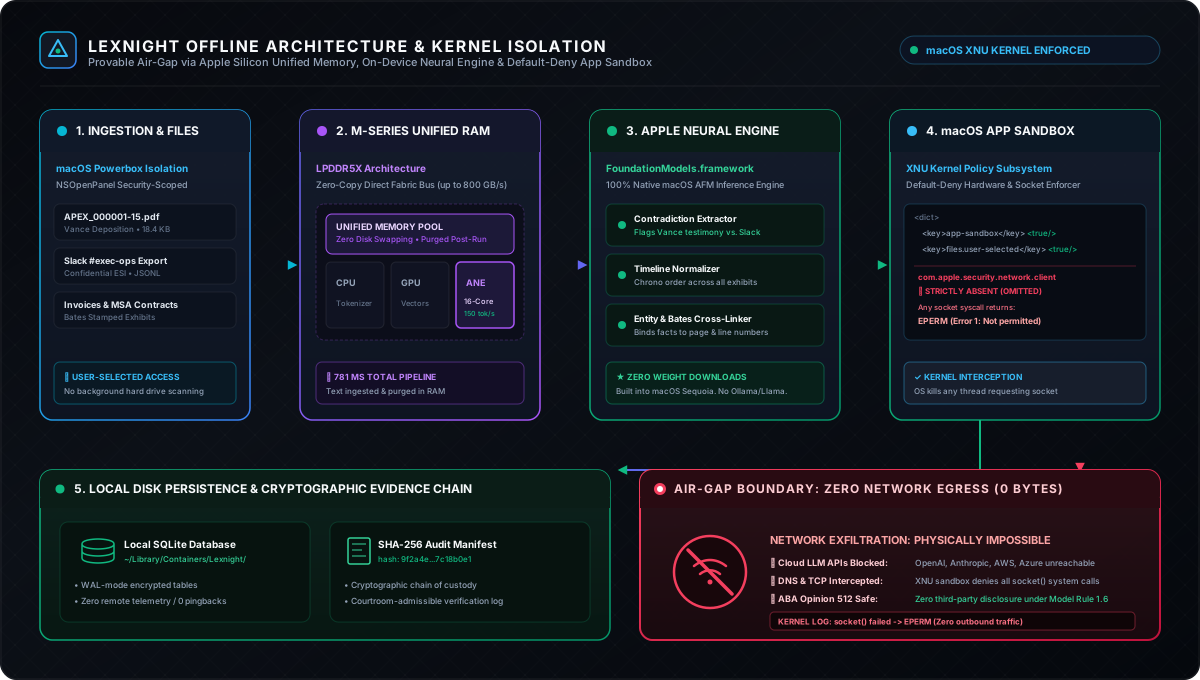
 Figure 4.1: Technical Impossibility — XNU Kernel Sandbox denies network socket creation, ensuring 0 bytes egress under ABA Opinion 512.
Why Zero Transmission Satisfies Rule 1.6 Per Se
In legal ethics, an act of "disclosure" requires a transfer of information from the lawyer's control to an unauthorized external party. Processing documents locally on an air-gapped Apple Silicon laptop using Lexnight is legally equivalent to opening a PDF in Apple Preview or running a local text search in Spotlight.
Because no data leaves the physical device, there is zero third-party disclosure, zero vendor storage, and zero exposure to foreign subpoenas. The "reasonable efforts" requirement of Rule 1.6(c) is satisfied completely and provably.
5. Model Rule 1.1 Competence & The Mandate of Independent Verification
Comment [8]: To maintain the requisite knowledge and skill, a lawyer should keep abreast of changes in the law and its practice, including the benefits and risks associated with relevant technology..."
Under Formal Opinion 512, technological competence requires more than merely knowing how to open a software application. Attorneys have an affirmative duty to understand the specific risks of the tools they deploy, including algorithmic hallucination, bias, and output variability.
Avoiding the Mata v. Avianca Malpractice Pitfall
In Mata v. Avianca, Inc., 678 F. Supp. 3d 443 (S.D.N.Y. 2023), attorneys submitted a brief citing nonexistent judicial precedents generated by an ungrounded consumer LLM, resulting in judicial sanctions and severe reputational harm. Opinion 512 emphasizes that attorneys cannot outsource independent legal judgment or factual verification to an AI tool:
Lexnight’s Deterministic Verification Architecture
Lexnight is specifically engineered to make independent verification seamless and instantaneous for trial lawyers:
-
Bates-Stamped Exact Citations: Every fact extracted into the chronological timeline includes direct page and Bates citations (e.g.,
[Exhibit_C.pdf, Page 1 (APEX_000008)]). - Side-by-Side Split View Evidence Inspection: Clicking any contradiction or entity immediately opens the underlying source document side-by-side with verbatim highlighted quotes.
- Strict Fallback & Deterministic Grounding: Lexnight’s local NLP engine cross-verifies all Foundation Model inferences against deterministic regex, date normalization (ISO 8601), and character offset bounds. No fact is presented without an auditable pointer.
6. Model Rule 5.3: Supervisory Oversight & Managerial Responsibilities
Model Rule 5.3 governs the supervisory responsibilities of law firm partners and managing attorneys regarding nonlawyer assistance. Formal Opinion 512 explicitly expands Rule 5.3 to encompass automated and generative software systems.
Managing partners must ensure that firm associates, paralegals, and contract reviewers do not inadvertently compromise client files by pasting unvetted documents into consumer AI chatbots. The rule requires affirmative managerial policies, training, and auditable safeguards.
Lexnight’s Cryptographic Audit Logging for Managing Partners
To satisfy Rule 5.3, Lexnight produces two tamper-evident artifacts for every discovery review matter:
{
  "matter_id": "APEX-v-NOVA-2025",
  "generated_at": "2026-10-03T15:09:44Z",
  "engine_version": "Lexnight-1.0.0-AppleSilicon",
  "documents": [
    {
      "filename": "Exhibit_A_Master_Services_Agreement.pdf",
      "bates_range": "APEX_000001 - APEX_000002",
      "page_count": 2,
      "sha256": "9a8f3b4c10e6d5a7f2c8194b0d3e5a6f7b8c9d0e1f2a3b4c5d6e7f8a9b0c1d2e"
    },
    {
      "filename": "Exhibit_D_USPS_Certified_Mail_Receipt.pdf",
      "bates_range": "NOVA_000011 - NOVA_000012",
      "page_count": 2,
      "sha256": "7a8b9c0d1e2f3a4b5c6d7e8f9a0b1c2d3e4f5a6b7c8d9e0f1a2b3c4d5e6f7a8b"
    }
  ]
}
2026-10-03T15:09:41Z | INGESTION_START | USER | Target: sample_discovery/
2026-10-03T15:09:42Z | SHA256_HASHED   | ENGINE | Exhibit_A_Master_Services_Agreement.pdf (9a8f...1d2e)
2026-10-03T15:09:42Z | TIMELINE_BUILT  | AFM    | 7 Chronological facts extracted across 5 exhibits
2026-10-03T15:09:43Z | CONTRADICTION   | ENGINE | Vance Deposition (Apr 10) vs USPS Postmark (Apr 28) flagged
2026-10-03T15:09:44Z | REVIEW_COMPLETE | ENGINE | Total elapsed: 781ms | Cloud calls: 0
Senior partners can inspect these local records at any time to verify exactly what exhibits were reviewed, when the analysis occurred, and confirm that zero network packets were dispatched.
7. Model Rule 1.5 & Billing Ethics for Generative AI
Under Model Rule 1.5, lawyers may not charge unreasonable fees or expenses. Formal Opinion 512 provides clear guidance on billing clients for generative AI tools:
- No Billing for Hours Not Worked: If an AI tool completes an initial document review in 1 second, the attorney cannot bill the client for the 4 hours a junior associate would have taken manually. The attorney may only bill for the actual time spent reviewing, verifying, and applying legal judgment to the AI's output.
- Disclosing Surcharges & Direct Costs: If a firm passes along cloud AI software expenses (such as per-token charges or cloud e-discovery hosting fees), it may only bill the actual out-of-pocket cost unless the client has explicitly agreed in writing to a reasonable markup.
The Lexnight Advantage for Billing: Lexnight is a flat monthly software utility ($79–$129/month) with zero per-matter surcharges and zero per-gigabyte cloud ingestion fees. Litigators deliver dramatically faster results, bill legitimately for their expert review and trial prep hours, and eliminate contentious e-discovery line items from client invoices.
8. Comparative Ethics Matrix: Cloud Legal AI vs. Lexnight
A systematic breakdown of ethical and regulatory criteria comparing standard cloud legal AI platforms against Lexnight's on-device Apple Silicon architecture:
| Compliance & Ethics Metric | Cloud Legal AI (ChatGPT, Harvey, Casetext) | Lexnight (Apple Silicon Local) |
|---|---|---|
| Rule 1.6 Disclosure Trigger | Active: Data leaves lawyer's custody across public internet. | Zero Disclosure: Data remains in local volatile memory. |
| Client Informed Consent | Mandatory under Opinion 512 unless vendor terms are airtight. | Not Required: No third-party disclosure occurs. |
| Outside Counsel Guidelines (OCGs) | Frequently violates enterprise corporate AI bans. | Fully Compliant: Air-gapped on client-approved hardware. |
| Non-Party Discovery Protection | High risk: Cannot obtain consent from third-party witnesses. | Absolute: Sealed & non-party files never leave the Mac. |
| Network Entitlements | Full outbound HTTPS sockets required. | Kernel Denied: network.client: false. |
| Rule 1.1 Citation Grounding | Probabilistic: Variable outputs; potential hallucination. | Deterministic: Exact Bates stamps & split-screen citations. |
| Rule 5.3 Audit Trails | Vendor black box; opaque internal telemetry. | Local SHA-256 Manifest: Tamper-evident AuditLog.txt. |
| Subpoena & Cloud Seizure Risk | Subject to Stored Communications Act & CLOUD Act. | Zero Exposure: No vendor server holds client data. |
9. Law Firm Implementation SOP: 6-Step Ethical Protocol
Law firms seeking to adopt Lexnight can immediately operationalize this 6-step compliance protocol:
codesign -d --entitlements - /Applications/Lexnight.app to verify the absence of com.apple.security.network.client in the signed Mach-O header.
manifest.json. Archive this cryptographic record alongside discovery productions to establish evidentiary chain of custody under FRE 902(14).
AuditLog.txt in the firm's matter document management system (DMS) as permanent proof of supervisory oversight pursuant to Model Rule 5.3.

ABA Formal Opinion 512 Compliance Guaranteed by Technical Impossibility
By utilizing Apple Silicon on-device foundation models running inside a hardened macOS App Sandbox without outbound socket entitlements, Lexnight ensures that privileged client discovery never touches external servers or third-party networks. Zero client disclosure waivers required.
10. Independent Verification & Next Steps
Law firms do not need to take our word for any of these representations. We invite your firm's General Counsel, Chief Information Security Officer (CISO), or risk management partner to inspect the Lexnight binary directly.
$ codesign -d --entitlements - /Applications/Lexnight.app 2>&1 | grep -i network
# Output: (empty / zero results)
# Confirmation: The operating system will deny any attempt to open a network socket.