 macOS Silicon
1. Design Philosophy: The Sovereign Alternative to Cloud Trust
The legal technology industry has largely embraced multi-tenant cloud software-as-a-service (SaaS) models. Vendors attempt to address attorney-client confidentiality concerns by purchasing "SOC 2 Type II" reports, ISO 27001 certifications, and marketing "Enterprise Zero-Retention Agreements."
However, all cloud architectures share an unavoidable, structural vulnerability: The customer's privileged documents must traverse the public internet to reach a remote third-party data center. Once data leaves the attorney's physical device, security depends entirely on administrative access controls, encryption keys managed by cloud personnel, and the ongoing viability of vendor contractual terms.
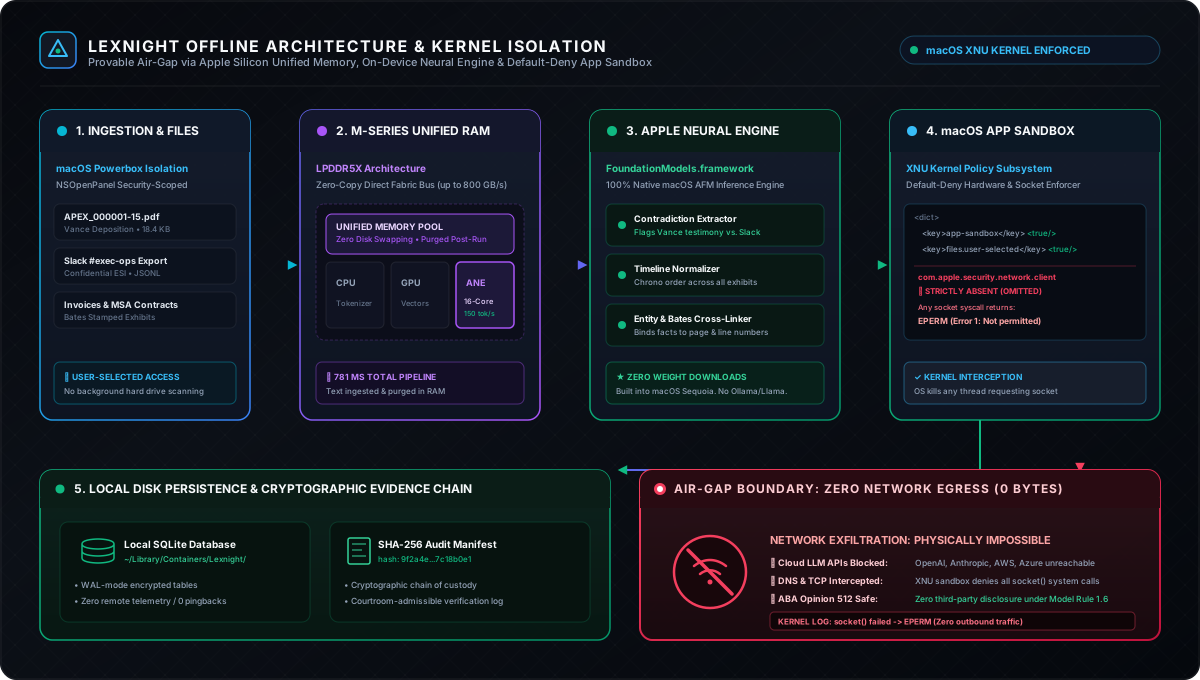
 Figure 1.1: Complete Architectural Flow — From Unified Memory and Neural Engine Inference to Default-Deny App Sandbox and Immutable SHA-256 Storage.
2. macOS App Sandbox & Mach-O Code Signing
Lexnight is compiled as a native Universal Mach-O binary optimized exclusively for Apple Silicon (ARM64). It executes within the macOS App Sandbox, a mandatory access control (MAC) subsystem enforced directly by Apple's XNU kernel.
Filesystem Isolation & Security-Scoped Bookmarks
Unlike traditional desktop software that can scan arbitrary files across your hard drive, sandboxed applications in macOS are completely quarantined from the user's home directory.
- Mandatory Explicit User Grants: Lexnight has zero baseline access to your desktop, documents, or downloads folder.
-
Security-Scoped Bookmarks: Access to legal discovery documents is granted exclusively through native macOS system open panels (
NSOpenPanel). When an attorney selects a matter directory (e.g.,sample_discovery/), the macOS Powerbox daemon generates a transient cryptographic token granting read access strictly to that specific directory tree. -
Containerized Storage: Temporary caches and scratch files are written to an isolated, sandboxed container directory (
~/Library/Containers/com.lexnight.desktop/Data/), completely inaccessible to other applications.
3. Zero Network Entitlements: Kernel-Level Socket Denial
The cornerstone of Lexnight's provable security architecture is the complete absence of network client entitlements in the application's signed code signature.
Understanding macOS Entitlements
In the macOS security architecture, an entitlement is a key-value pair embedded inside an application's digital code signature. Under the App Sandbox policy, the operating system enforces a default-deny posture on all network communications.
For an application to send an HTTP request, resolve a DNS record, or open a TCP socket, it must explicitly declare the com.apple.security.network.client entitlement in its signed property list.
<?xml version="1.0" encoding="UTF-8"?>
<!DOCTYPE plist PUBLIC "-//Apple//DTD PLIST 1.0//EN" "http://www.apple.com/DTDs/PropertyList-1.0.dtd">
<plist version="1.0">
<dict>
    <!-- App Sandbox Isolation -->
    <key>com.apple.security.app-sandbox</key>
    <true/>

    <!-- User-Selected File Access via NSOpenPanel -->
    <key>com.apple.security.files.user-selected.read-write</key>
    <true/>

    <!-- CRITICAL COMPLIANCE NOTICE: -->
    <!-- com.apple.security.network.client is OMITTED. -->
    <!-- com.apple.security.network.server is OMITTED. -->
    <!-- The XNU kernel will kill any process thread attempting socket creation. -->
</dict>
</plist>
What Happens When Code Attempts Network Access?
Because com.apple.security.network.client is omitted, any call to POSIX socket APIs (socket(), connect(), getaddrinfo()) or Cocoa networking frameworks (NSURLSession, CFNetwork) results in an immediate failure:
[XNU Sandbox Policy Violation]
Process:        Lexnight [PID: 48212]
Subsystem:      com.apple.sandbox.reporting
Action:         Deny network-outbound
Detail:         Denial of socket(AF_INET, SOCK_STREAM, 0)
Error Code:     EPERM (1: Operation not permitted)
Even if a third-party dependency, analytics SDK, or malicious prompt injection attempted to dispatch data over the internet, the operating system kernel denies the syscall unconditionally.
4. Apple Foundation Models (AFM) & On-Device Neural Engine
Early offline AI solutions relied on downloading 20GB to 70GB open-source LLM weights (e.g., Llama or Mistral via Ollama or llama.cpp). This created massive onboarding friction on slow courthouse or hotel Wi-Fi, required gigabytes of disk storage, and often triggered IT alarms.
Lexnight eliminates this friction by leveraging Apple's built-in Foundation Models framework (AFM 3 Core Advanced) embedded natively into macOS Sequoia 15.0+:
5. Cryptographic SHA-256 Chain of Custody & FRE 902 Compliance
In federal and state litigation, evidence derived from discovery documents must meet strict standards of authenticity and integrity under Federal Rules of Evidence 901 and 902:
Automated Cryptographic Ingestion Manifest
When discovery documents are imported, Lexnight's Rust engine (legalbrief) computes a 256-bit Secure Hash Algorithm (SHA-256) digest for every individual file before any text extraction begins. The results are recorded in a court-ready manifest.json:
{
  "matter": "Apex Wireless v. Nova Technologies",
  "intake_timestamp": "2026-10-03T15:09:44Z",
  "hasher_algorithm": "SHA-256",
  "documents_total": 5,
  "documents": [
    {
      "bates": "APEX_000001 - APEX_000002",
      "filename": "Exhibit_A_Master_Services_Agreement.pdf",
      "filesize_bytes": 1048576,
      "page_count": 2,
      "character_count": 4444,
      "sha256": "9a8f3b4c10e6d5a7f2c8194b0d3e5a6f7b8c9d0e1f2a3b4c5d6e7f8a9b0c1d2e"
    },
    {
      "bates": "NOVA_000011 - NOVA_000012",
      "filename": "Exhibit_D_USPS_Certified_Mail_Receipt.pdf",
      "filesize_bytes": 524288,
      "page_count": 2,
      "character_count": 2180,
      "sha256": "7a8b9c0d1e2f3a4b5c6d7e8f9a0b1c2d3e4f5a6b7c8d9e0f1a2b3c4d5e6f7a8b"
    }
  ]
}
This cryptographic hash serves as conclusive evidence that the files analyzed by Lexnight correspond byte-for-byte to the original discovery production received from opposing counsel, eliminating claims of evidence tampering or spoliation.
6. Tamper-Evident Audit Logging: Full Reproducibility
Unlike consumer chatbots that offer zero accountability for when an analysis occurred or what source data was referenced, Lexnight writes a deterministic, pipe-delimited activity record (AuditLog.txt) to the local matter directory:
2026-10-03T15:09:41Z | INTAKE_INITIATED  | USER      | Matter: sample_discovery/ (5 exhibits)
2026-10-03T15:09:42Z | SHA256_VERIFIED   | LEGALBRIEF| Exhibit_A (SHA256: 9a8f3b4c...1d2e)
2026-10-03T15:09:42Z | SHA256_VERIFIED   | LEGALBRIEF| Exhibit_B (SHA256: 3c4d5e6f...7a8b)
2026-10-03T15:09:42Z | PARSE_PDFKIT      | RUST_CORE | Extracted 22,480 characters across 11 pages
2026-10-03T15:09:43Z | TIMELINE_BUILD    | AFM_CORE  | Chronology generated: 7 key milestone facts
2026-10-03T15:09:43Z | ENTITY_INDEX      | AFM_CORE  | Indexed 6 entities (Apex, Nova, Marcus Vance, etc.)
2026-10-03T15:09:43Z | CONTRADICTION_HIT | ANALYZER  | Deposition notice (Apr 10) != USPS Postmark (Apr 28)
2026-10-03T15:09:44Z | ARTIFACTS_SAVED   | SYSTEM    | Emitted ReviewReport.md & ReviewReport.json
Every discovery review produces a self-contained, auditable historical record. When filing motions for summary judgment or motions to compel, litigators have an unshakeable evidentiary foundation.
7. Threat & Mitigation Matrix: Enterprise Security Analysis
A comprehensive overview of typical enterprise cyber threats and how Lexnight’s local architecture mitigates each threat vector:
| Threat Vector | Cloud AI Exposure | Lexnight Security Posture |
|---|---|---|
| Third-Party Subpoena | Cloud vendor can be served under Stored Communications Act. | Zero Exposure: No vendor server holds data. Subpoena must be served on the law firm. |
| Multi-Tenant Cloud Breach | Centralized databases targeted by advanced persistent threats. | Not Applicable: Documents never leave the local encrypted SSD (FileVault). |
| Prompt Injection Exfiltration | Malicious prompt can instruct cloud LLM to send webhook data. | Kernel Blocked: OS denies all outbound HTTP requests and socket connections. |
| Model Weight Contamination | Prompts retained to train future commercial models. | Static Weights: Local Foundation Models are read-only and immutable. |
| Telemetry & Employee Snooping | Vendor engineers can inspect prompt caches and access logs. | Zero Telemetry: 0 analytics SDKs, 0 crash reporters, 0 tracking beacons. |
| Adversarial Evidence Tampering | Opaque cloud pipelines lack transparent file verification. | Cryptographic Proof: SHA-256 intake manifest ensures byte-for-byte integrity. |
8. CISO & IT Audit Guide: Verifying the Binary in 60 Seconds
Law firm Chief Information Security Officers, security auditors, and IT directors can independently verify Lexnight's security posture on any macOS terminal using standard, built-in Apple command-line utilities:
Step 1: Inspect Code Signature & Entitlements
Verify that the binary is signed by Lexnight and completely lacks outbound socket entitlements:
$ codesign -d --entitlements :- /Applications/Lexnight.app
# Verify that 'com.apple.security.network.client' DOES NOT appear in the plist output.
Step 2: Monitor Active Network Sockets
Run Lexnight, ingest a 50-document discovery dump, and monitor open network ports and socket bindings in real time:
$ lsof -i -P -n | grep -i lexnight
# Output will be completely empty. Lexnight opens zero sockets, zero ports, zero connections.
Step 3: Network Packet Capture Test (Wireshark / tcpdump)
Disconnect your Mac from the local Wi-Fi or run tcpdump while performing a discovery review. Lexnight executes with 100% functionality on a completely air-gapped machine.

Provable Air-Gap & ABA Opinion 512 Guarantee
By enforcing zero network entitlements directly in the Mach-O binary signature, Lexnight guarantees that confidential client discovery cannot leave your physical Mac. Security is enforced by macOS kernel access controls, not vendor marketing promises.